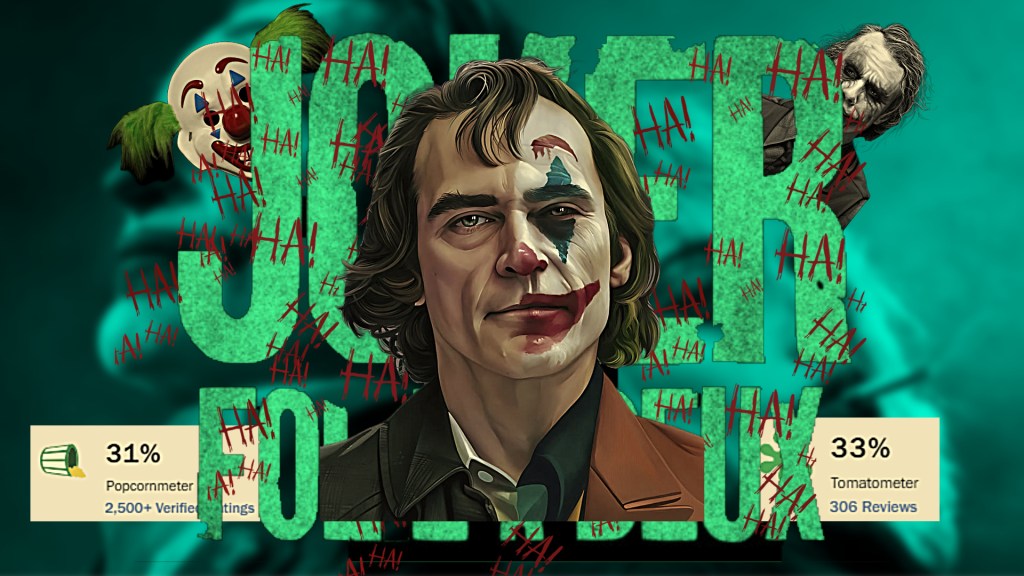
Okay, okay, okay—enough is enough. The slander against Joker: Folie à Deux has to stop. As a diehard DC fan, I understand the disappointment. We all wanted the perfect, bloody, violent Joker origin story. After watching Joaquin Phoenix’s portrayal in 2019, I thought, “Here it is—the setup for a deep dive into one of the greatest villains we’ve loved to hate for decades.”
The Sequel’s Direction
However, Todd Phillips’ sequel took a different direction—interesting, to say the least. We follow Arthur Fleck—just Fleck, nothing more (but more on that shortly). Before we dive deeper, let’s take a moment of silence for Joaquin’s masterful portrayal of the character.
…
Alright, let’s get to the crux. Critics and fans have dragged this movie for various reasons: the plot feels redundant compared to the first film, the drawn-out musical sequences, and the lingering question of whether this universe is building up to a Harley Quinn origin story. Side note: it would be cool if we actually get to see her team up with the real Mr. J down the line.
But Todd Phillips confirmed that this sequel will mark his departure from the DC cinematic universe. Given the surprisingly low box office performance Folie à Deux has pulled in, I doubt anything will come of this DC timeline.
The Ending
This brings us to the ending, arguably the biggest criticism of the movie. According to Insider and Time Magazine, it can be summed up like this: “Folie à Deux is about… well, nothing. It feels like a movie for no one.” After watching it for myself, I get it. The hardest part for me—as an optimist, despite the low pre-release reviews—was watching Fleck die in prison, left with the question: “What was it all for?”
Two hours of watching a mentally ill man destroy cigarettes, paint his face, fantasize about a woman, and then… nothing? Outside of the gate scene and a few short hallucinations, we never even see him crash out. It’s all in his head.
The Shift in Perspective
After the movie ended, I found myself questioning my life choices. But then I decided to think about it differently—through the lens of a born-and-raised New Yorker.
Let’s be real: we wanted Fleck to get the evil happily ever after he was destined for. But in terms of Gotham—this twisted, supercharged version of New York—this movie nailed it. Arthur Fleck’s life behind bars, going from martyr to nothing more than a joke, a memory lost within the broader movement that is the Joker, reflects the institutional cycle of suppression marginalized groups face. When the film reveals that Arthur Fleck isn’t even the real Joker but a tragic figure of mental illness consumed by his delusions, it drives home a chilling message. Fleck embodies not just one man’s descent into madness, but the countless invisible people—those failed by a broken system, discarded by society, and left to die in obscurity.
He was never destined to be Gotham’s greatest villain—just another victim of it. In a city that builds its legends on the backs of the forgotten, Fleck’s story feels disturbingly familiar.
Think about it. The Arthur Flecks of the world—the homeless, the mentally ill, the criminalized—never get to be heroes or villains. They’re pawns in the game, ghosts in a city that has already decided their fate. The fact that Fleck dies in prison, murdered by a nameless inmate, proves that his story was never about becoming the Joker but about how society produces countless ‘Flecks’ who will never rise above the system that crushes them.
Now, I doubt Todd Phillips meant for the film to be seen this way, but as a fan of Gotham—a city similar to mine in many ways—I was at least relieved to see those explicit, invasive, yet real aspects of an unjust world brought to life. It’s worth noting that Folie à Deux translates to “madness of two,” a fitting title that paints a picture of the shared insanity between Arthur Fleck and the societal structures that shape him. I believe “Folie à Deux” was a ‘joke’ deliberately, a climactic middle finger, I’d say. But this film also remind us that the chaos we witness isn’t solely Fleck’s—it reflects the collective madness we all have within us.
A Deeper Look at Fleck
Maybe Arthur Fleck was just an incel chasing sexual validation. Or maybe he was a man stripped of friendship, mercy, and love, denied at every turn. His right to life, liberty, and the pursuit of happiness was revoked by being born in Gotham. Was he a monster who killed five people for fun, or were those acts a desperate cry for help echoing through the streets?
We’ll never know for sure. But it’s always struck me how Batman seems to be fighting against Gotham just as much as he’s fighting to save it.
Conclusion
Maybe Joker: Folie à Deux was never about giving us a resolution but about offering that haunting perspective. Is it worth it? That’s up to you. Quite honestly, this perspective helped me sleep peacefully at night after watching this sequel… well, shit the bed.
And as you ponder that, why not hit that like and subscribe button? Especially if you made it this far!
Thanks for reading—I’m Enoch Naklen, and as always: Good morning, good evening, and goodnight.

