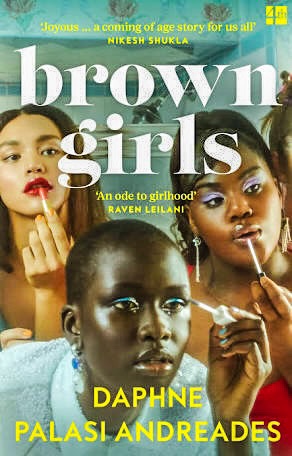
Daphne Palasi Andreades’s debut novel, “Brown Girls” is unlike anything I’ve personally read before. Through the omniscient perspective of ‘Brown Girls’ in the East Coast, Andreades narrates the collective experiences of minority women as they transition from childhood to adolescence, and then adulthood. Thanks to the unconventional structure of the novel, “Brown Girls” is able to touch on various aspects of a Brown Girl’s life that makes it both enjoyable and exponentially harder than one would imagine.
Now I will say, there are many concepts Andreades explores really well in “Brown Girls” that I won’t be able to get to within my 10 quotes. Ideas on death, gentrification and the dynamic of interracial relationships are just a few topics that make this novel something to invest your time into.
That being said, let’s start with
10. “Our brothers smoke their cigarettes, and in time, stronger substances we cannot recognize” (Your Own Kind, pg.4)
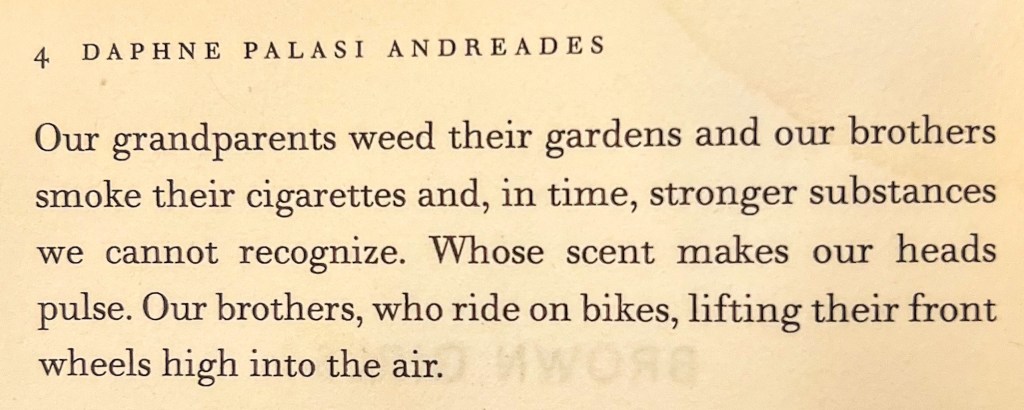
Although this novel is mainly about Brown Girls, Andreades is also able to squeeze in trends of Brown boys through the perspective of their female counterparts. In doing so, the reader is given a fragmented, yet informative view on what it means to be a man of color in America.
I initially loved this quote for the poetic wording Andreades uses here. It almost feels prophetic, as the “stronger substances” outlined here, refers to the same “” the Brown Boys would go to jail for later in the book.
Andreades uses the smoking of cigarettes at a younger age to highlight the common gateway drugs popular in minority households, especially for men in the community. Nicotine, alongside alcohol, shows up a lot in Brown Girls, which makes this quote increasingly ironic as we see it does indeed go from just smoking cigarettes and drinking here and there as kids, to a consistent getaway from the struggles of life for both brown boys and girls.
9. “If you really want to know, we are the color of 7-eleven root beer.” (Brown, pg.5)
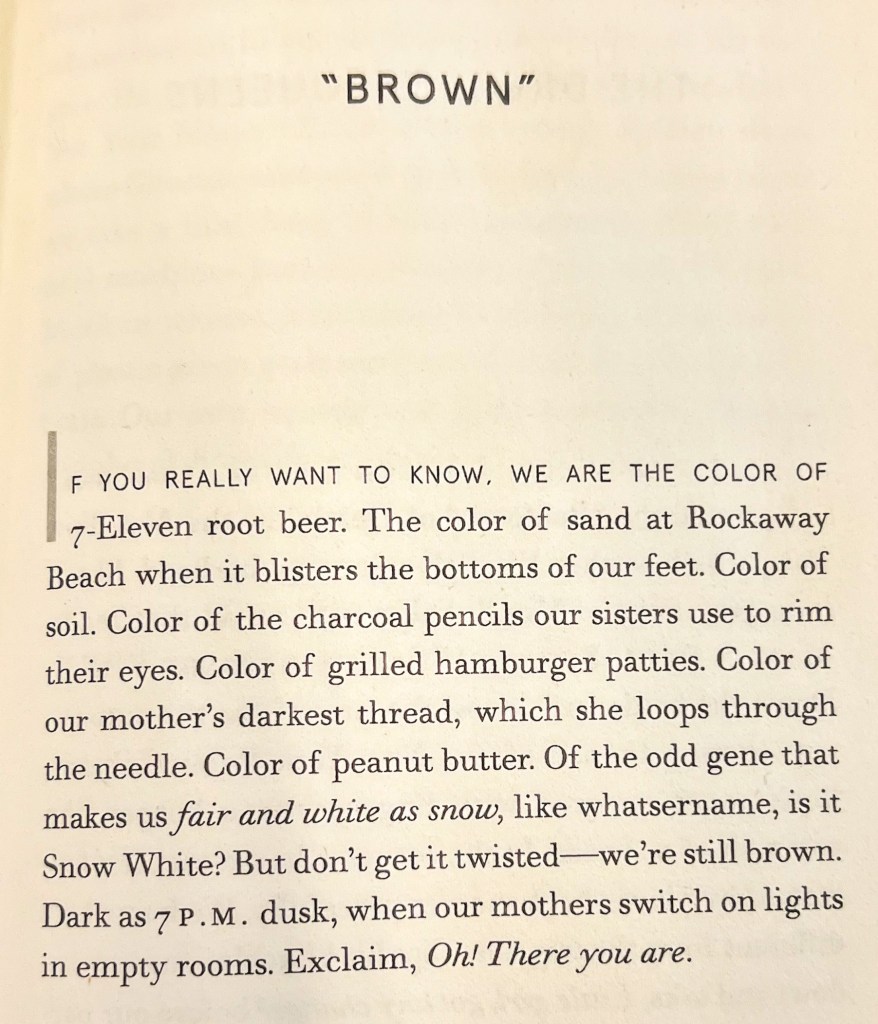
If you didn’t catch the memo by the title, Andreades made sure we as reader understand; These girls referenced throughout the book are BROWN. But Brown, as Andreades also highlights in this chapter (ironically named Brown), comes in different tints, tones, and shades. Maybe some Brown Girls are the color of 7-eleven root beer, but other Brown girls are the color of Sand at Rockaway Beach, and even more others that have the “odd gene” that makes them as fair and white as snow. All Brown.
This is the core understanding that Andreades complicates through many challenges we’ll break down later. However, I can say that the zoomed in imagery displayed by Andreades in this chapter really humanizes the characters by comparing their skin to staples in minority communities all throughout NYC.
**Sidenote: Andreades first 3-5 chapters establishing the main setting of the novel was amazing. She had me hooked from early. **
8. “Our Brothers’ NYS Arrect Record” (Our Brothers pg.90)
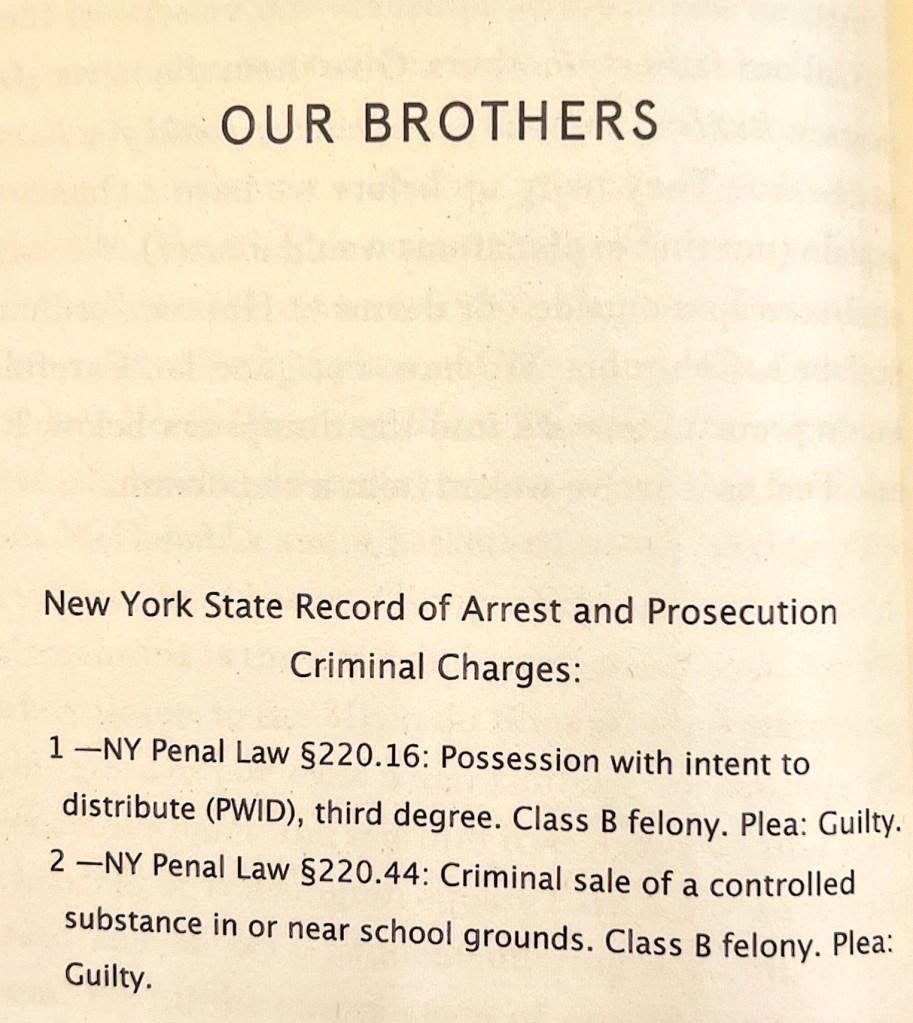
It was hard trying to digest the generalizations that Andreades would make about Black Boys in this book. I found myself reading the first part of “Our Brothers” over and over, not because I couldn’t understand the overall point of the school to prison pipeline for minority men (which I will talk about in a minute). No, I read this section over to give myself the space as to not dissociate from the book, as that was my immediate reaction. I mean, this idea that Brown boys are rarely brought up, much less an active member in the lives of a Brown Girls life, and when they are brought up, it feels like an update on the downward spiral they’ve been on since birth. This is not the reality I come from as a Black young adult, and the lack of diversity expressed about the futures of Black boys made me often feel disconnected from the book. The representation of what a Brown Boy is isn’t relevant for this book, but I know from firsthand experience that that the “school to prison pipeline” isn’t the only path for Black young men so it rubbed me the wrong way that that was the main story arch for the “Brothers” in “Brown Girls.”
However, removing my personal feeling from the equation, I thought the passive storyline of the Black “statistic” through the “school to prison pipeline” as mentioned earlier was underlined well by Andreades. We see the beginnings of the pipeline in “Great Expectations” where Andreades contrasts the continuous track record of Dean’s office visits and poor teacher relationships of Brown Boys with the full merit scholarships Brown Girls would receive for their excellent grades throughout High School. Andreades feeds into this tragedy, as she foreshadows that although Brown Boys at that younger age believes they could still have a successful career; that they could still “make it out, the Brown girls can see how the system has doomed their brothers.
7. “We know we don’t belong here” (Welcome to Mars, pg. 77)

It becomes increasingly clear throughout this novel that Andreades is very intentional with her words and thoughts. In the Chapter, “Welcome to Mars” Andreades doesn’t give the Brown Girls the benefit of uncertainty and ignorance going into college. These Brown Girls KNOW they don’t belong in these prestigious college/universities across the country because they have already been thrusted into places like Stuyvesant and Brooklyn Tech by age 14; white dominated places that don’t represent or embrace them as an asset to the community. Everywhere that wasn’t the “dregs of Queens” not only felt foreign, but also in a way felt ‘too good’ for Brown Girls. That feeling of KNOWING they don’t belong may have started in high school as they ventured into the nicer parts of NYC, but it only became more amplified with the transition into college.
To be successful, it felt imperative for Brown Girls to blend into their white counterparts, which was hard considering these counterparts had the luxury of ignorance deriving from having pleasures such as being a legacy student and… Well just being white in America. Those were luxuries that were made painfully clear that Brown Girls would never get to have.
Andreades highlights the effect of the contrasts between the Brown Girls and the white dominated spaces they’re in very well by portraying signs of Imposter Syndrome. Many times, Brown girls are described as feeling inadequate no matter how many accomplishments they rack up. Andreades makes it a point to constantly compare the backgrounds of Brown Girls to the newer environments, in which the native background never quite seems to stack up.
Many times, Brown girls express their desires to go back home and concede to the challenges Imposter Syndrome presents for them. Statements from family like “Don’t go too far” and “You think you’re too good for us” always crept back up in the minds of Brown Girls.
This one hit home for me personally, as I also had my battles with Imposter Syndrome going to a specialized High School. At that age, I didn’t even know what Imposter Syndrome was. By now, I’ve learned to deal with the feeling, and embrace who I am regardless of the space I’m in.
Andreades introducing the topic in such a relatable way throughout the novel really warmed my heart and makes BROWN GIRLS an amazing read for those battling with the same mental uncertainty.
6. “Boys don’t cry. Boys weep.” (Our Brothers, pg.92)

One thing I love about Brown Girls is the way Andreades allows her strong sentences to metaphorically float, going from one packed sentiment to the beginning of an entirely different moment.
In the chapter, “Our Brothers” we see the black young men these Brown Girls grew up with complete the pipeline, heading off to prison. However, Andreades made a point to say that, although they’re going through such a traumatic experience, these boys “don’t cry.” Even if everything inside them wants to. That sensitive, emotional part of the boys that allowed them to feel comfortable doing things such as crying disappeared a long time ago. Now, the only emotions that feel comfortable are the ones that are raw, and uncultivated. “Boys weep” when the thousands of emotions bottled up within them finally spill over. They are human, it’s just very hard, and thus rare, we see those parts of Brown boys as they turn into men. That process of emotional hardening was one we don’t get to see as we’re immersed in the lives of Brown Girls throughout this novel. So that one sentence on the emotions of these Brown Boys is easy to miss.
The tragedy of toxic masculinity is one that plagues many households, specifically minority households. The pain we as Black men carry almost feels inappropriate to express. The vulnerability we lock away. And thus, Andreades was right to let this float. To move on to the next sentence without further explanation of what this quote means. From the outside looking in, it doesn’t look like anything too deep to digest because there isn’t much past the surface that’s shown.
5. “We are the grateful brown people”- (Everything We Ever Wanted, pg.57)

“We are the grateful Brown people.” I mean, just reading it back, it’s hard to fathom that there is a section of ignorant people who find nothing wrong with that sentence, much less to say to a POC. Microaggressions is something Andreades makes sure to highlight consistently throughout the novel. Sadly, microaggressions such as this seem to age with the Brown Girls as they grow up. “We are the grateful Brown People” came from the white family of their first white boyfriend, and was taken in stride by the brown girl because well, what do you say to that? There is no definite response to microaggressions, as Andreades points out that for a lot of Brown Girls, the natural response is to not say anything at all as to maintain the validation from being accepted by the white person they’ve been raised to think highly of (in some ways higher than themselves).
One of my favorite parts of the book came later in the book where the Brown Girls would reunite (in the chapter called Reunion) after going off to separate colleges and share their stories with microaggressions. By then, the Brown Girls had grown a greater confidence in their own skin, so in response to questions like “is Queens dangerous” the brown girl said, “Well I could cut you right now.” Another reaction went like this “I can’t read it aloud; my mom watches my videos” (can put in subtitles).
Microaggressions is something most minorities face at some point when encountering ignorant people, and because for the most part the insult is masked by the ignorance, Brown people, or in this instance, Brown girls struggle to navigate those interactions for a really long time. Andreades emphasizes this topic really well, mixing up the tone from lighthearted to really offensive throughout the novel.
4. “’American Dream.’ But for what? And for who?” (Welcome to Mars! pg.79-80)
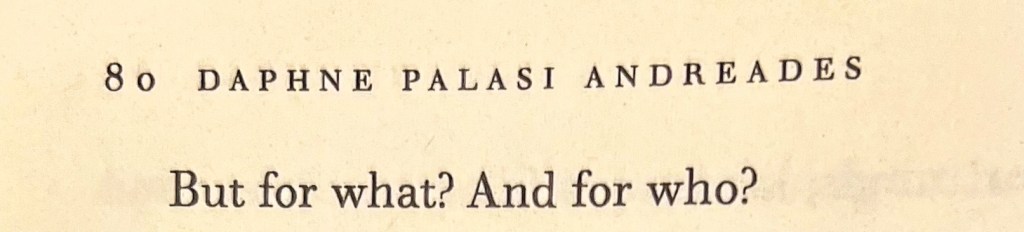
The Brown Girls of this book don’t get the privilege of having parents that’re “hip” to the modern world. For a lot of Brown Girls, their parents are first-generational. Others have parents that just weren’t able to live a life outside of what they knew was safe. The contradictory idea of not going too far from the Dregs of Queens while exceeding expectations in practically all aspects of life was out of love. Their version of the “American Dream” was simply creating a world safer and pleasurable than that of their pasts.
I don’t think Andreades places blame on the parents for the damage they’d done on their Brown Girls while trying to make their Dream come reality. However, it does often seem daunting for these same Brown girls to decipher the sense from nonsense their parents provide. Many times, those sentiments of the “American Dream” came off as limiting and confining to the Brown Girls. The worst part about it is the respect these girls have for their parents makes the guidance overconsuming. There seems to be an instilled part of the Brown Girls that wants to please their parents no matter the cost, which often comes as a detriment to them.
Fortunately, in every Brown Girl’s life, she begins to understand their parents as we will discuss later.
3. “We’re Too Frightened to Pray… We are ‘good girls’. We are good girls.” (Jenny, pg.85)
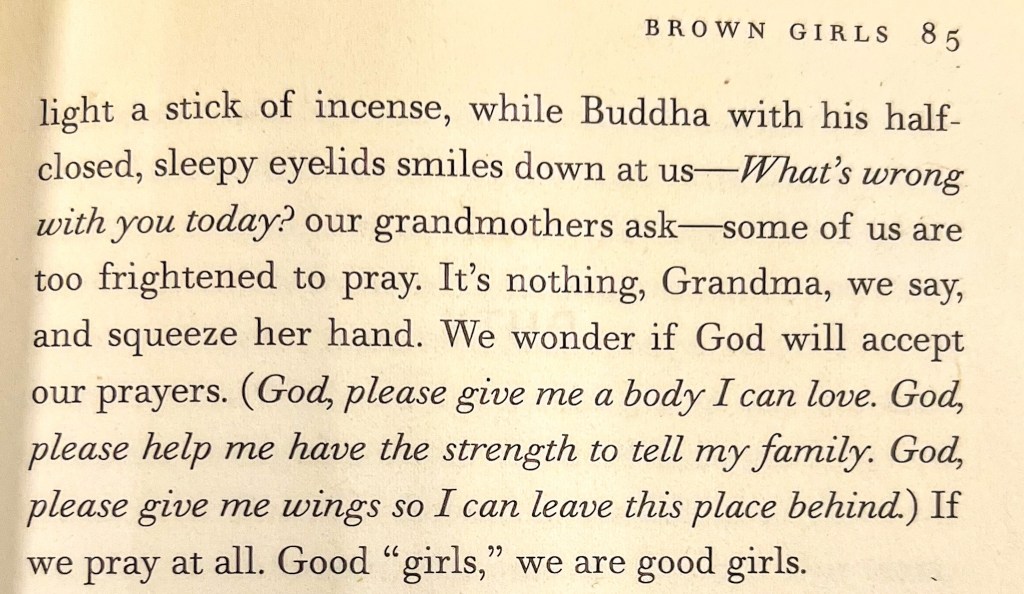
The Chapter this quote comes from, Jenny, is actually one part of 2 chapters that share the same name. Andreades separates these two by almost 80 pages which makes sense given that these chapters outline the continuous struggle with gender and sexual identity Brown Girls go through. “Jenny” stands for the crushes Brown girls would develop for other girls. However, for a lot of Brown girls, the crush only goes as far as being a crush. On the *relative* surface, this is because of the dangers of being a part of the LGBTQ+ community in the United States. In a country where hate crimes on LGBTQ+ members seem common, there is a sense of worry being public about their sexuality and gender.
However, what made these chapters strong for me was the intersection between religion and sociocultural backgrounds that served as an even stronger internal barrier for the Brown Girls that wanted to explore their identity. As Andreades points out in this quote, Black Girls fear the rejection by family, and by extension GOD for their deviation from the norm.
I say “by extension” on purpose, as Andreades makes a point to emphasize that the line between familial values and God are blurred for Brown Girls. This idea is best expressed in the chapter “Mom’s Commandments,” which plays on the 7 commandments set in stone by God in the Book of Exodus. The 5th commandment is the most telling. I mean it literally says that Brown Girls must “Obey, for I am the Lord.”
The expectation of being a “good girl” as defined by family makes it really hard for Brown Girls to ever feel comfortable in their own skin, and most girls, as Andreades expresses, never get that comfortability, even later in life.
2. “Our grandmothers refuse canes”-Brown Girls, pg.1)

Before I dissect this quote, let’s take a second to truly honor the strong women of color. Across history, women of color have been both our sung unsung heroes, with impact spanning all aspects of life. In the household, I grew up in, my mom was the strong woman of color I had as an example of who I aspire to be in life.
Andreades gives credit to the matriarchs of the lives of Brown Girls in a bittersweet way, emphasizing both the strength and resilience of women of color, and the tireless, seemingly never-ending task of being the perfect mother while juggling the struggles of life.
As adolescents, it’s hard for Brown girls to genuinely appreciate their mothers for their efforts. Many times, it was hard to connect to their mothers on an emotional level, with a blockage formed because of the mothers trying to mold the girls into their version of success.
It takes time, and adulthood, for the now Brown women to empathize with their mothers. (Find quote when you get home) The irony of it all is the generational curse of emotional blockages between mother and daughter present themselves with the Brown girls and their mothers. It wasn’t until the Brown girls subconsciously made the same mistakes their mothers made for them realized that it’s a lot harder said than done raising a child.
1. “Hoy, pare!” (Territory ,p. 62)
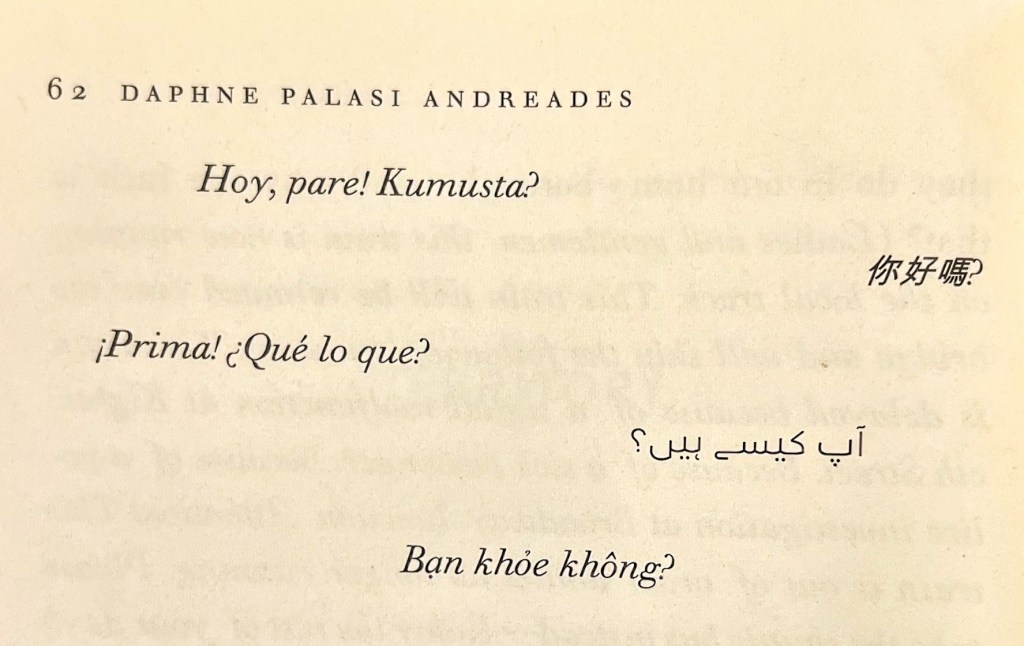
I thought the way Andreades structured this string of sentences was very cool. I mean, visually, the way each phrase looks seems to directly contrast with each other. And on the surface up till this point of the book, that would make sense. Andreades never specifies which ethnicities she’s referring to in her novel, and for a large part of it, it felt as though she would switch from one ethnicity to the next.
However, in these sentences, each phrase comes from a different culture but ironically means about the same thing. And no, I don’t just know that because I’m multilingual.
The chapter in which this quote lives is called Territory. In this chapter, Andreades details the memories of young brown girls introducing their white partners to their home area. We know by context from the page before that these are all the common things brown girls hear when they enter the local park they grew up in as kids.
Now, it was only here, two whole sections into the book, that I began to understand what “Brown Girls” truly meant. “Brown Girls,” as Andreades uses it, does not refer to one nationality but instead every GOC (Girl of color), as the experiences detailed in the novel are something that to some extent is relatable to each and every one of you.
Where “Brown Girls” thrives as a novel is its ability to weave together the collective hardships and accomplishments of minorities in a way that makes it relatable to any POC of any background. Although Andreades appoints a specific protagonist for the entire book, many times the protagonist of the story feels like every brown girl on the East Coast.
In that way, Brown girls is an amazing reflection on the harrowing tale of the life of East coast brown girls, but even more than that, instills a weirdly comforting message that, even when it feels like it, you are never alone. There are other brown girls like you that feel how you feel; brown girls that share almost identical experiences to you despite being a different race or ethnicity.
Rating
Personal Enjoyment: 8.5
Plot/Structure: 7.8
Relevance:9
Overall score: 8.4
“Brown Girls” is a strong debut for Daphne Palasi Andreades, and as a current Baruch student, I’m inspired seeing the work that comes from this school. Her versatility as a writer was put on display in this novel, and I can’t wait to see how Andreades is able to top “Brown Girls” her next piece (as I’m sure she will). I encourage every Brown Girl on the East Coast and beyond to give this book a read. It really does a great job of giving minority girls a novel that speaks about their issues that are otherwise kept under the radar.

